
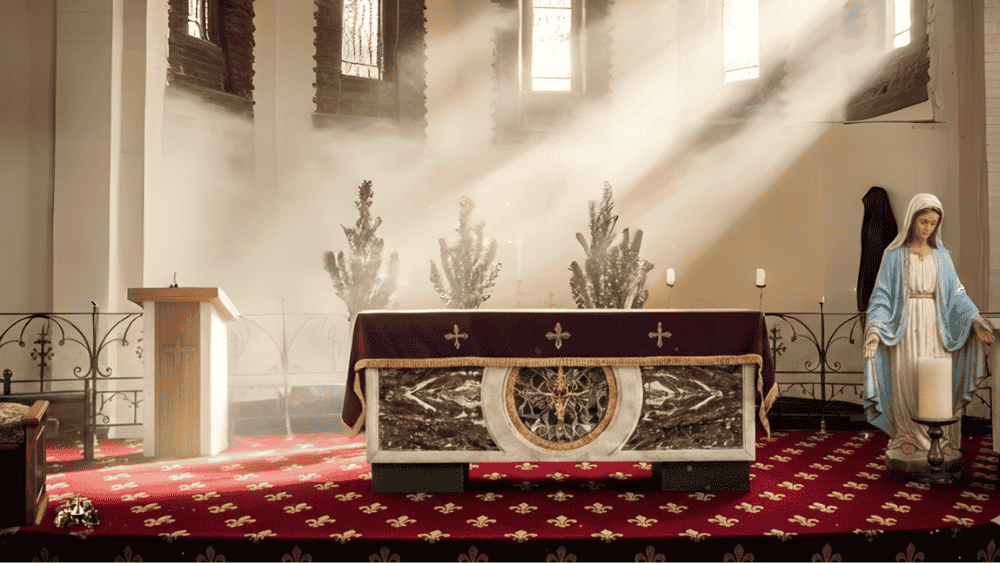
They only gave the novices the 6pm Monday service - a liturgical training ground where one's inevitable failures would unfold before an audience of approximately ten souls who had chosen, for reasons best left unexamined, to attend weeknight Mass. This was where altar boys learned the choreography of this sacred theatre: when to stand, when to kneel, when to process with candles, when to just sit and - most crucially - when to ring the bells.
The bells. Four small, dome-shaped bells hanging downwards - a carillon of four ceremonially paramount chimes. Their purpose was to signal the moment of transubstantiation - that precise instant when, according to two millennia of theological doctrine, bread and wine ceased being bread and wine and became the actual body and blood of Christ.
I had insisted on "doing the bells". This, in retrospect, demonstrated either remarkable confidence or a complete failure to grasp what was being asked of me. The other new altar boys had wisely selected less fraught responsibilities: carrying the water and wine, holding the missal or just sitting there. But I, in my infinite youthful wisdom, had volunteered for the role that required split-second accuracy, absolute attention and the ability to remain composed while performing a task that had been executed flawlessly by centuries of altar boys before me.
Father Whoever - I genuinely cannot recall his name, which tells you something about how much I retained from that period beyond lapsed devotion - had explained it with the sort of patient solemnity one uses when instructing someone in a task that cannot be rehearsed but must be performed correctly on the first attempt. "When I elevate the host," he said, "you ring the bells. Three times. Then again when I elevate the chalice".
Simple enough. Except that during the actual Mass, with its weight of ritual and seriousness pressing down like some atmospherically intensifying tropical low, my own internal bombogenesis was brewing. I became acutely aware that I had no idea - none whatsoever - when the elevation would occur. I had seen this so many times before, but today it was like I was in some altar induced trance. I watched Father Whoever's hands with the intensity of a cardsharp holding a straight flush, awaiting his opponent's reveal with the creeping certainty that somehow, miraculously, he held the royal. Was that the moment? No - still preparatory gestures - Now??? No, I was hearing words I had heard a thousand times but today they may as well have been Latin. Surely now? Oh God, is it happening and I've missed it?
And then it happened.
Father Whoever lifted the host. I rang the bells. A beat too early. Or possibly too late. The timing was just wrong - cosmically, liturgically, unmistakably wrong. The sound seemed to echo in the sparse church with accusatory clarity. Oh dear.
And then, because the human nervous system can be a magnificent traitor, I began to laugh.
It started as a small, stifled snicker, but while bringing my hand to my face to disguise it as a cough, I hit the bells and they rang AGAIN. So now, a full, mounting wave of nervous laughter that I could feel building from my core, unstoppable as a sneeze was no longer able to be controlled. I tried - genuinely tried - to maintain composure. I bit the inside of my cheek. I squirmed on the pew. I delved for deeply solemn thoughts. None of it worked. I decided to focus on the Mary statue on the other side of the altar. What would she think?
Father Whoever shot me a look - not angry, exactly, but painfully weary. The expression of a man who had seen many altar boys fail in many ways and had long ago accepted this as part of his pastoral burden. Mrs. O'Brien, stationed in her usual third pew, developed a sudden intense interest in her missal.
The remaining eight parishioners pretended, with admirable commitment, that nothing unusual was occurring at the altar. The transubstantiation proceeded. I continued my quiet hysteria, bells clutched in sweating hands, waiting for the chalice elevation with the dread of someone awaiting a lost package delivery from Temu.
When the moment came, I rang the bells with such over-corrected precision that they sounded less like a sacred signal and more like a stilted staccato tinkle with the tentative self consciousness of an adolescent bower bird attempting to attract its first mate. Ahh well.
One must revere the Catholic Church's commitment to ritual over reality. Despite my peculiar clumsiness with the bells, the Mass continued. The bread was still the body, the wine was still the blood, regardless of whether some child with bells had managed to punctuate the transformation correctly, the sacred machinery ground on.
I was not allowed to do the bells again.